What is Local Currency Financing?
Local Currency Financing (LCF) enables resilient, inclusive, and sustainable infrastructure by structuring loans and bonds in a country’s own currency. It reduces exchange rate risk, strengthens domestic financial systems, and is emerging as a transformative tool for financing infrastructure in Emerging Markets and Developing Economies (EMDEs).
LCF enables countries to pursue Green, Resilient, and Inclusive Development by reducing reliance on volatile foreign capital and unlocking domestic financial resources.
Mitigating Exchange Risks
Protects projects from currency mismatch and rate fluctuations.
Reducing Debt Burden
Frees budgets by lowering reliance on hard currency.
Mobilizing Savings
Channels pensions & insurance funds into infrastructure.
Enhancing Resilience
Builds stable markets, protects from shocks.
“Local currency financing is becoming a pivotal tool for advancing sustainable infrastructure, aligning with green, resilient, and inclusive development goals.”
– World Bank, Unlocking Local Finance for Sustainable Infrastructure
LCF enables countries to pursue Green, Resilient, and Inclusive Development by reducing reliance on volatile foreign capital and unlocking domestic financial resources.
“Local currency financing is becoming a pivotal tool for advancing sustainable infrastructure, aligning with green, resilient, and inclusive development goals.”
– World Bank, Unlocking Local Finance for Sustainable Infrastructure
The global infrastructure financing gap is widening. EMDEs need approximately 4.5%of GDP annually to meet infrastructure needs, with climate goals adding urgency.
Global Gap by 2040
$15 trillion
Annual Global Shortfall
~$1 trillion
Next 25 years infrastructure requires
~$64 trillion
Climate-Infrastructure Annual Gap
~$3 trillion
“Innovative solutions are essential to mitigate foreign exchange risks and strengthen domestic financial markets. Building robust local credit and capital markets offers a sustainable, long-term approach.”
- World Bank Treasury & PPIAF
The global infrastructure financing gap is widening. EMDEs need approximately 4.5% of GDP annually to meet infrastructure needs, with climate goals adding urgency.
“Innovative solutions are essential to mitigate foreign exchange risks and strengthen domestic financial markets. Building robust local credit and capital markets offers a sustainable, long-term approach.”
- World Bank Treasury & PPIAF
By anchoring infrastructure finance in domestic currency, LCF unlocks long-term development outcomes that extend far beyond individual projects.
Institutional Deepening & Market Maturity
boosts long-term lending, credit flow, and resilient markets.
Countercyclical Stability & Crisis Buffering
sustains investments and protects jobs when foreign capital retreats.
Policy Coherence & Sovereign Control
reduces debt reliance and strengthens government control.
SDG Alignment
funds climate goals, just transition, and inclusive services.
Financing Innovation
local guarantees, bond enhancements, and funds for underserved sectors.
By anchoring infrastructure finance in domestic currency, LCF unlocks long-term development outcomes that extend far beyond individual projects.
Toolkit Overview
The Toolkit helps countries assess readiness, spot gaps, and find solutions for financing infrastructure in local currency.

Toolkit
A digital resource designed to help countries unlock local currency for sustainable infrastructure by aligning policy reforms, project design strategies, and financial instruments with local market conditions and investor needs.
Outputs
 Diagnostic Assessment
 Reports
 Guidance Notes
 Other Documents
1A: Diagnostic Assessment
A self assessment that evaluates a country’s readiness to mobilize LCF for sustainable infrastructure and provides tailored interventions.
1B: Enabling Environment
A standalone report identifying institutional, regulatory, and market reforms needed to create a supportive environment for LCF.
2: Demand of Finance
Standalone report on structuring and scaling LCF-friendly projects, which offers guidance notes and other documents.
3: Supply of Finance
Standalone report on structuring and scaling financing solutions focused on pooled investment vehicles (PIVs) and risk mitigation strategies (RMS), which offers guidance notes and other documents
DiagnosticUndertake assessment for enabling environment, demand of finance and supply of finance
This assessment provides gaps & recommendations for enabling environment, demand of finance and supply of finance for local currency financing
Benefits

 Identify policy and structural gaps
- Strengthen readiness for local currency financing
- Support informed decision-making.
Enabling Environment
Strengthen policies, institutions to support sustainable LCF
Assess legal frameworks, regulatory clarity, institutional roles, and technical capacity for effective local currency financing.
Benefits

- Policy and regulatory alignment.
- Institutional and technical capacity
- Strengthen investor trust through stable governance.
Demand of Finance
Develop pipeline and structure LCF-friendly projects to generate demand of finance
Develop pipeline and structure LCF friendly projects
Benefits

- Develop program and project pipelines
- Structure LCF friends projects
- Build investor confidence.
Supply of Finance
Evaluate the capacity of local markets to provide sustainable funding
Assess instruments and financing for infrastructure
Benefits
- Expand financing options.
- Explore pooled investment vehicles(PVs) and risk mitigation solutions
- Scale other related financing instruments
Resources
Access resources such as reports, case studies, guidance notes and other documents
- Reports
- PDF - 1.57 MB
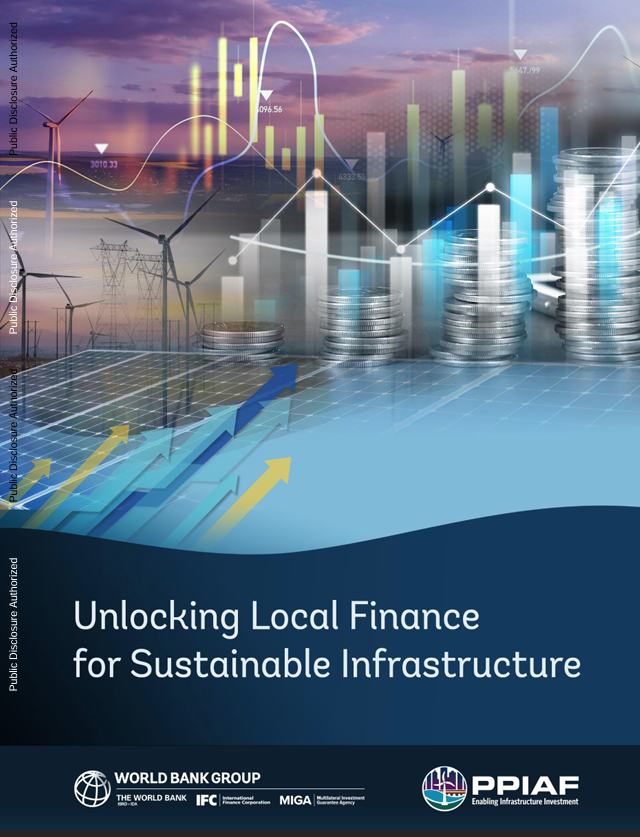
Unlocking Local Finance For Sustainable Infrastructure
This study aims to further address gaps in research related to commercial financing challenges in Local Currency Financing (LCF) for sustainable infrastructure. This will include a review of broader financial market challenges with a focus on credit/banking markets.



Data & Trends
Country assessments and country factsheets
Training
Expert-led training to strengthen skills & knowledge in sustainable finance
Questions?
Find answers to the most common questions about the toolkit, implementation and support options.
Lorem ipsum dolor sit amet, consectetur adipiscing elit, sed do eiusmod tempor incididunt ut labore et dolore magna aliqua. Ut enim ad minim veniam, quis nostrud exercitation ullamco laboris nisi ut aliquip ex ea commodo consequat. Duis aute irure dolor in reprehenderit in voluptate velit esse cillum dolore eu fugiat nulla pariatur. Excepteur sint occaecat cupidatat non proident, sunt in culpa qui officia deserunt mollit anim id est laborum.
A typical assessment takes 20–30 minutes to complete, depending on the depth of responses provided. The process is designed to be concise yet thorough, allowing users to move through structured questions efficiently while still capturing meaningful insights.
Lorem ipsum dolor sit amet, consectetur adipiscing elit, sed do eiusmod tempor incididunt ut labore et dolore magna aliqua. Ut enim ad minim veniam, quis nostrud exercitation ullamco laboris nisi ut aliquip ex ea commodo consequat. Duis aute irure dolor in reprehenderit in voluptate velit esse cillum dolore eu fugiat nulla pariatur. Excepteur sint occaecat cupidatat non proident, sunt in culpa qui officia deserunt mollit anim id est laborum.
Lorem ipsum dolor sit amet, consectetur adipiscing elit, sed do eiusmod tempor incididunt ut labore et dolore magna aliqua. Ut enim ad minim veniam, quis nostrud exercitation ullamco laboris nisi ut aliquip ex ea commodo consequat. Duis aute irure dolor in reprehenderit in voluptate velit esse cillum dolore eu fugiat nulla pariatur. Excepteur sint occaecat cupidatat non proident, sunt in culpa qui officia deserunt mollit anim id est laborum.
Lorem ipsum dolor sit amet, consectetur adipiscing elit, sed do eiusmod tempor incididunt ut labore et dolore magna aliqua. Ut enim ad minim veniam, quis nostrud exercitation ullamco laboris nisi ut aliquip ex ea commodo consequat. Duis aute irure dolor in reprehenderit in voluptate velit esse cillum dolore eu fugiat nulla pariatur. Excepteur sint occaecat cupidatat non proident, sunt in culpa qui officia deserunt mollit anim id est laborum.